
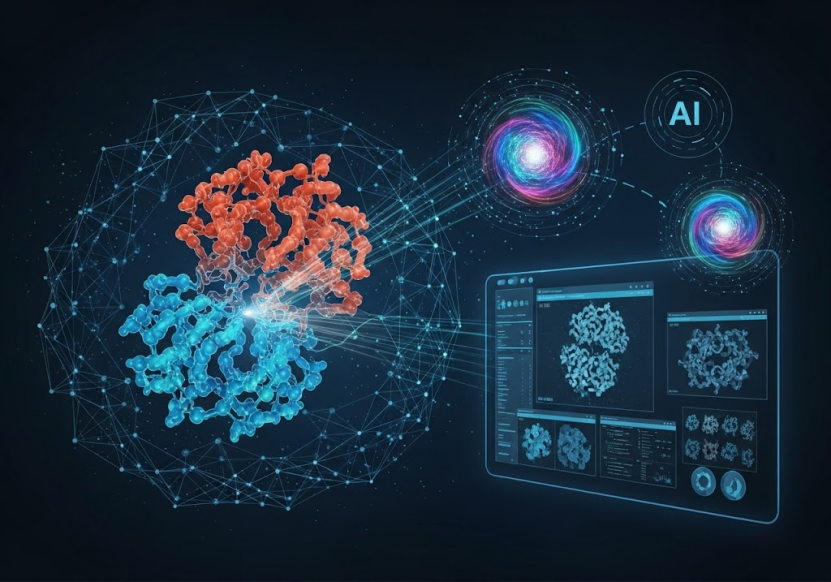
Cryo-electron microscopy (cryo-EM) has revolutionized structural biology, allowing researchers to determine the high-resolution three-dimensional structures of complex biological molecules that are difficult or impossible to crystallize. From proteins like membrane receptors and enzymes to large assemblies like viruses and ribosomes, cryo-EM provides crucial insights into their function and interactions. This structural information is indispensable for fundamental research and accelerates drug discovery efforts, supporting the development of vaccines, antibody drugs, and small molecule therapeutics.
However, cryo-EM structure determination, particularly the Single Particle Analysis (SPA) method, involves processing vast amounts of data. The typical workflow includes sample preparation, freezing, data collection (acquiring numerous two-dimensional images of individual particles), 2D particle picking, 3D classification, and finally, 3D reconstruction of the macromolecule's structure from these images. Each of these steps, especially the cryo EM data processing and cryo em reconstruction phases, can be computationally intensive and time-consuming, presenting bottlenecks in the research pipeline.
Efficient and accurate cryo EM data processing is paramount to achieving high-resolution structures and accelerating the overall research timeline. This is where innovative approaches, particularly those leveraging artificial intelligence (AI), are making a significant impact.
Introducing Shuimu Bio: A Leader in Cryo-EM Services
Shuimu Bio, founded in 2017 at Tsinghua University, stands out as Asia's first commercial platform dedicated to providing comprehensive cryo-EM structure analysis services. The company boasts a core team of accomplished life scientists, computational scientists, IT experts, and pharmaceutical industry professionals. Leveraging the deep scientific and technological expertise in structural biology from Tsinghua University, Shuimu Bio has developed advanced and reliable experimental and data analysis workflows.
With the largest commercial cryo-EM platform globally, featuring eight 300 KV cryo-electron microscopes (two in Beijing and six in Hangzhou), Shuimu Bio is well-equipped to handle a high volume of projects. The platform is supported by professional engineers ensuring optimal instrument performance and a global customer service team facilitating communication and feedback. Beyond imaging, Shuimu Bio also operates a comprehensive protein expression and purification platform, offering an end-to-end solution from gene sequence to high-resolution 3D protein structure. This integrated approach minimizes potential issues caused by sample transportation between different service providers.
The One-Stop SPA Solution: From Sample to Structure
Shuimu Bio offers a "One-stop" SPA solution, covering the entire process from sample preparation to final structure delivery. The Single Particle Analysis (SPA) technique is a powerful tool for resolving the high-resolution 3D structures of biomacromolecules like proteins and viruses. The process involves collecting numerous 2D images of purified particles and using computer algorithms for processing and reconstruction.
The typical workflow provided by Shuimu Bio includes:
· Project consultation and initial evaluation.
· Plan confirmation and contract/payment.
· Protein expression and purification (if needed).
· Negative staining characterization (for preliminary sample assessment).
· Sample freezing and data collection.
· 2D particle picking from the collected images.
· 3D structure reconstruction from the picked particles.
· Model refinement.
· Final data delivery.
This integrated workflow is designed to save time and cost for researchers. The 3D structure reconstruction phase is where the fundamental three-dimensional shape of the molecule is computationally built based on the different 2D views captured in the images. Achieving a high-quality, high-resolution cryo em reconstruction depends heavily on the quality and quantity of data, as well as the efficiency and sophistication of the downstream data processing algorithms.
Accelerating Cryo-EM Reconstruction with AI-Driven Data Processing
One of Shuimu Bio's key advantages is its AI-driven platform. The company has independently developed the SMART software series, which utilizes AI technology to enhance cryo-EM data analysis efficiency.
AI's Role in Cryo-EM Data Processing: While the sources specifically mention that Shuimu's SMART software uses AI to improve overall data analysis efficiency, reduce machine runtime, and decrease the required data volume, general knowledge about the field indicates that AI algorithms are increasingly being applied to various steps within the cryo EM data processing workflow to achieve these goals. These applications often include (information on specific AI applications beyond Shuimu's claimed benefits is general knowledge unless specifically cited from the sources):
· Automated Particle Picking: Traditionally, picking individual particles from noisy raw micrographs could be a manual or semi-automated process requiring significant user input. AI, particularly deep learning models, can be trained to accurately identify and select particles more rapidly and reliably, even from challenging datasets [General Knowledge]. This speeds up a critical initial step in cryo EM data processing.
· Improved 2D Classification: AI can help group similar 2D particle images more effectively, filtering out "junk" particles and providing cleaner datasets for subsequent 3D reconstruction [General Knowledge]. Better classification leads to higher quality inputs for the final structure calculation.
· Accelerated 3D Classification and Reconstruction: Advanced AI techniques are being explored to optimize the alignment and classification of particles in 3D space, potentially speeding up the iterative processes involved in cryo em reconstruction [General Knowledge].
· Enhanced Image Quality and Noise Reduction: AI can be used to improve the signal-to-noise ratio in cryo-EM images, making particles easier to pick and leading to better alignments and reconstructions [General Knowledge].
· Workflow Optimization: AI can potentially optimize parameters and streamline the connections between different data processing steps, reducing the need for manual intervention and speeding up the overall process [General Knowledge].
Shuimu Bio's SMART Software: The sources explicitly state that Shuimu's independently developed SMART software leverages AI to boost cryo-EM data analysis efficiency. Furthermore, they highlight that the SMART software helps reduce machine runtime and the amount of data required. By improving the efficiency of the entire cryo-EM data analysis process, the SMART software directly contributes to accelerating the time it takes to get from raw data to a finalized cryo em reconstruction. This efficiency is a significant advantage, especially for clients who require rapid turnaround times for their research or drug discovery projects. The AI-driven platform is listed as a key advantage for both the one-stop SPA solution and the 24h machine time service.
Shuimu Bio's AI-Powered Tools: SMART Software and NanoSMART
Beyond the general claims about the SMART software's impact on data analysis efficiency, Shuimu Bio also utilizes AI in other specialized tools. For instance, their Cryo-characterization service employs NanoSMART, an AI cryo-EM system specifically designed for nanoparticle analysis. NanoSMART can automatically recognize features of nanoparticles, such as lipid nanoparticles (LNP), liposomes, AAV, and other viral vectors, directly from electron microscope images. It provides detailed reports on properties like size distribution, circularity, lamellarity, and full/empty status. The system can even enhance the clarity of low-quality images to improve recognition accuracy. While primarily used for sample characterization before high-resolution SPA, NanoSMART exemplifies Shuimu's capability in applying AI to complex image analysis tasks relevant to cryo-EM workflows.
The integration of AI, particularly through the SMART software, into Shuimu Bio's cryo EM data processing pipeline directly translates into benefits for clients. Faster and more efficient data processing means that the critical step of cryo em reconstruction can be reached sooner, and the subsequent model refinement can be performed more quickly. This accelerates the overall project timeline and reduces the time researchers spend waiting for structural results.
Overcoming Challenges with AI and Advanced Technology
Cryo-EM experiments are often challenging, especially when dealing with samples that are small, at low concentrations, exhibit strong background noise, or suffer from preferred orientation issues. Traditional grids and processing methods can struggle with these samples, making it difficult to obtain enough high-quality particles for 3D reconstruction.
Shuimu Bio addresses some of these challenges not only through advanced imaging facilities and an expert team, but also through proprietary materials and AI-enhanced processes. They have developed a series of graphene-based support films called GraFuture™ (including GO and RGO types). These grids are specifically designed to improve sample preparation for challenging targets, offering potential solutions for issues like preferred orientation and problems caused by the air-water interface. GraFuture™ grids also help when dealing with proteins of small molecular weight, low concentration, or high background noise. While the sources don't explicitly link GraFuture™ use directly to the AI data processing workflow, optimizing sample preparation at the initial stage is crucial for maximizing the efficiency and success rate of downstream cryo EM data processing and reconstruction. Fewer problematic particles or better particle distribution resulting from advanced grids can make the AI's task of particle picking and classification more effective, ultimately contributing to faster and more accurate cryo em reconstruction.
Furthermore, Shuimu's extensive experience, with over 400 cryo-EM projects and successful reconstruction of over 150 protein structures with resolutions reaching a breakthrough 1.8 Å and even 1.4 Å in some cases, combined with their ability to handle small proteins (as low as 51 kDa), demonstrates their capability to apply advanced techniques, including AI-driven workflows, to a wide range of targets.
Impact on Drug Discovery and Research
The acceleration of cryo EM data processing and cryo em reconstruction has a direct and significant impact on drug discovery and basic research.
In vaccine development, rapid reconstruction of viral structures and protein complexes (like spike proteins bound to receptors or antibodies) allows researchers to quickly understand viral mechanisms and design more effective vaccines. Cryo-EM is used for analyzing structures of viruses like SARS-CoV-2, influenza, and measles, as well as for quality control of vaccine particles. Faster processing means quicker insights to counter emerging viral variants.
For antibody drug development, understanding how an antibody binds to its target antigen at high resolution is critical for optimizing its efficacy and specificity. Efficient cryo em reconstruction of antibody-antigen complexes accelerates this process. Cryo-EM also helps in studying the mechanism of action of antibody drugs and resolving structures of challenging membrane protein targets like GPCRs, which are common drug targets.
In small molecule drug development, determining the high-resolution structure of a drug target, especially complex ones like membrane proteins or enzyme complexes, is the first step. Cryo em reconstruction of these targets, and their complexes with small molecule ligands, provides invaluable structural basis for rational drug design. AI-accelerated data processing means these target structures can be determined faster, speeding up fragment-based drug discovery and studies of drug binding mechanisms. Shuimu Bio has experience resolving structures of GPCRs and other complex targets relevant to small molecule drug discovery.
By reducing the time and computational resources needed for cryo EM data processing and reconstruction, Shuimu Bio's AI-driven platform allows researchers and pharmaceutical companies to obtain crucial structural information more quickly, accelerating decision-making and advancing their R&D pipelines.
Shuimu Bio's Experience and Capabilities
Shuimu Bio's expertise is underpinned by its cutting-edge facilities and experienced team. Their cold electron microscopy center is equipped with high-end 300kV instruments featuring advanced detectors, energy filters, spherical aberrations, and phase plates to ensure maximum imaging quality. These instruments are maintained to ensure high annual availability and uptime.
The team comprises PhD-level scientists from top institutions with expertise in structural biology, protein science, and computational biology. Their collective experience spans numerous projects across diverse sample types, including membrane proteins, soluble proteins, viruses, and protein complexes. The successful cases published in top-tier journals, detailing the structures of ion channels, GPCRs, and antibody-antigen complexes determined using the Shuimu platform, serve as strong validation of their capabilities.
This combination of advanced hardware, experienced personnel, proprietary tools like GraFuture™ grids, and the innovative AI-driven SMART software positions Shuimu Bio to effectively tackle challenging cryo-EM projects and provide efficient, high-resolution structure determination services.
Conclusion
Cryo EM data processing and cryo em reconstruction are critical, yet often time-consuming, steps in obtaining high-resolution biological structures via cryo-EM. Accelerating these processes is key to advancing structural biology research and speeding up the development of new therapeutics. Shuimu Bio is at the forefront of this acceleration through its investment in cutting-edge cryo-EM technology, a team of leading scientists, and particularly, the development and implementation of AI-driven solutions like the SMART software.
By leveraging AI to enhance the efficiency of their cryo-EM data analysis process, reduce machine runtime, and potentially lower the required data volume, Shuimu Bio enables researchers to obtain high-quality structural information faster and more reliably. This not only improves the efficiency of individual projects but also accelerates the pace of scientific discovery and drug development across various fields, including vaccine research, antibody therapeutics, and small molecule drug design.
For researchers and companies seeking rapid, high-resolution structural insights from challenging biological samples, Shuimu Bio offers a powerful, integrated solution powered by advanced technology and AI.
To learn more about how Shuimu Bio can accelerate your cryo-EM research and drug discovery programs with their AI-driven cryo EM data processing and cryo em reconstruction services, please visit https://shuimubio.com/.