
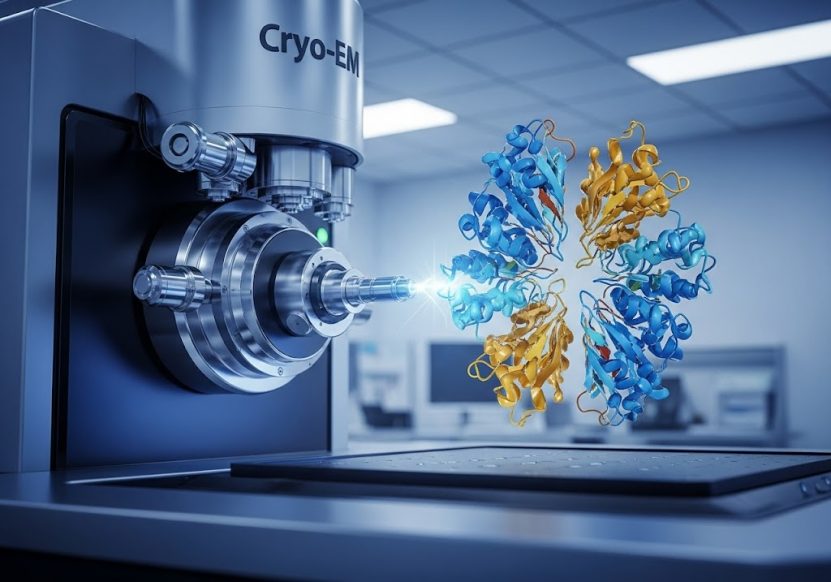
Understanding the three-dimensional structure of proteins is fundamental to uncovering their functions and developing targeted therapies. While computational methods like homology modelling can provide valuable insights into protein structure by predicting models based on known related structures, experimental techniques are essential for achieving high-resolution details and validating structural hypotheses. Cryo-Electron Microscopy (Cryo-EM), particularly Single Particle Analysis (SPA), has revolutionized structural biology, allowing scientists to move beyond prediction and obtain experimental structures of complex biological macromolecules in near-native states.
ShuimuBio is at the forefront of this revolution in Asia, established in 2017 with a core team of experts from diverse scientific backgrounds, including life science, computational science, IT, and the pharmaceutical industry. As Asia's first commercial platform offering Cryo-EM structure determination services, ShuimuBio leverages deep scientific and technical expertise to provide advanced, reliable experimental operations and data analysis workflows. The company aims to achieve a one-stop solution from gene sequence to high-precision 3D protein structure.
The Power of Cryo-EM in Protein Structure Determination
Cryo-EM is a powerful technique used to resolve the high-resolution three-dimensional structure of biological macromolecules. Unlike traditional methods that often require protein crystallization, Cryo-EM can work with samples in a frozen, hydrated state, preserving their near-native conformations. This is particularly advantageous for proteins that are difficult to crystallize, such as membrane proteins.
ShuimuBio offers a comprehensive suite of Cryo-EM services centered around Single Particle Analysis (SPA). SPA involves taking numerous two-dimensional images of purified biological macromolecule particles and using computational algorithms to process and reconstruct these images into a high-resolution three-dimensional structural model. This method is effective for a wide range of biological samples including antibodies and antigens, small molecules and targets, PROTACs, membrane proteins (such as GPCRs, ion channels, and transporters), VLPs, and peptides.
The advantages of using Cryo-EM SPA for protein structure analysis are significant:
· Preserves samples in a near-native state, reflecting their biological conditions more accurately than some other methods.
· Captures various conformational states, providing insights into the dynamic nature of proteins and their interactions.
· Requires relatively small amounts of sample compared to some other techniques.
· Can determine the structures of heterogeneous protein complexes, which are often challenging for other structural methods.
ShuimuBio's platform is equipped with advanced Cryo-EM facilities, including a large number of 300kV electron microscopes (currently 8 instruments with plans for expansion, including 2 in Beijing and 6 in Hangzhou based on platform details, or up to 12 in Beijing and 6 in Hangzhou based on service description). These instruments are designed for high-quality structure determination, featuring high-performance detectors, energy filters, spherical aberration correctors, and phase plates to maximize image quality. Regular maintenance ensures optimal performance and high operational availability.
Complementing the state-of-the-art hardware is ShuimuBio's top-tier scientist team, composed of PhD-level scientists specializing in structural biology, protein science, and computational biology from leading institutions. Their extensive experience, accumulated from over 200 Cryo-EM projects and the resolution of over 150 protein structures, covers diverse samples from membrane proteins to antigen-antibody complexes. ShuimuBio consistently strives for extreme resolution, achieving best resolutions of 1.8 Å and even breakthrough resolutions of 1.4 Å in some cases, demonstrating their capability in resolving fine structural details. They have successfully determined the structure of proteins as small as 51kDa.
An innovative aspect of ShuimuBio's service is their AI-driven platform. They have independently developed the SMART software series, which utilizes AI technology to enhance Cryo-EM data analysis, improving efficiency and precision. For negative staining and characterization services, they employ NanoSMART, an AI system designed to automatically identify characteristics of nanoparticles like size distribution, circularity, layer structure, fullness/emptiness, and integrity from microscope images. For MicroED, they developed eTasED software which seamlessly integrates MicroED technology with standard Cryo-EM systems.
Beyond Prediction: Addressing Sample Challenges
Obtaining high-quality samples is paramount for successful experimental protein structure determination via Cryo-EM. This is a critical step where experimental methods differentiate themselves from predictive approaches like homology modeling. ShuimuBio provides comprehensive protein preparation and analysis services to ensure the samples are suitable for Cryo-EM. These services include various protein expression systems (E. coli, mammalian cells, insect cells, cell-free systems), purification processes (affinity chromatography, ion exchange chromatography, gel filtration chromatography, RP-HPLC), and protein characterization methods (SDS-PAGE, Western blot, mass spectrometry, thermal stability, solubility, SPR, BLI, ELISA). Their platform has deep experience in the complex field of membrane protein production and purification.
Furthermore, ShuimuBio has developed proprietary consumables like the GraFuture™ series of graphene oxide support films. These specialized grids are designed to overcome common challenges in Cryo-EM sample preparation, such as air-liquid interface absorption, severe preferred orientation, high sample concentration thresholds, strong background noise, and difficulties in reconstructing the structure of small molecules. By providing a potential solution to preferred orientation and other issues, GraFuture™ GO (Graphene Oxide) and RGO (Reduced Graphene Oxide) grids help facilitate high-quality data collection, essential for resolving accurate protein structures, especially for difficult samples.
Homology Modelling of Protein vs. Cryo-EM
Homology modelling of protein is a computational method used to predict the three-dimensional structure of a protein based on the known experimental structure of a homologous (related) protein, often referred to as the template. This method is useful when an experimental structure is not available, allowing researchers to generate a plausible structural model relatively quickly. However, the accuracy of a homology model is heavily dependent on the sequence similarity between the target protein and the template. If the sequence identity is low (e.g., below 30%), the model may contain significant errors. Furthermore, homology models are typically static representations and may not accurately capture dynamic protein conformations, post-translational modifications, or the structure of large, complex assemblies. They also rely entirely on existing experimental data for their template, meaning truly novel protein folds cannot be predicted accurately by this method.
In contrast, Cryo-EM is an experimental technique that determines the actual structure of the protein directly from imaging data. It provides a high-resolution snapshot (or multiple snapshots) of the protein's structure in a near-native environment, including complex formation with other molecules or different conformational states. While initial models or structural insights from homology modelling of protein might be helpful for guiding experimental design or data analysis, **Cryo-EM provides the definitive, experimental protein structure that goes beyond prediction. It can reveal novel structural features, confirm or refute predicted interactions, and provide the precise atomic coordinates needed for detailed mechanistic understanding and rational drug design. For example, determining the structures of protein-ligand or protein-antibody complexes is crucial for drug discovery, information that is difficult to obtain accurately through homology modelling of protein alone, especially for novel ligands or antibodies. Cryo-EM provides the empirical evidence needed for high-confidence structural data.
Applications of Cryo-EM Protein Structure Analysis
High-resolution protein structures determined by Cryo-EM are invaluable across various fields, particularly in drug discovery and vaccine development.
In small molecule drug discovery, resolving the structure of the target protein (such as membrane proteins or enzymes) is the critical first step. Cryo-EM enables detailed visualization of the target's binding sites and interactions with small molecule ligands. This structural information is vital for rational drug design, allowing researchers to design molecules with high selectivity and efficacy. Cryo-EM can also be used to study the mechanism of action by resolving complexes of the target with agonists or antagonists, revealing how drugs activate or inhibit signaling pathways. It shows significant potential in fragment-based drug discovery (FBDD) by revealing detailed interactions between small molecule fragments and protein targets, aiding in screening and optimization. ShuimuBio's "one-stop" crystal structure analysis service, which utilizes X-ray crystallography but is part of their integrated offering, also provides high-resolution structures of small molecules, peptides, and proteins, complementing their Cryo-EM capabilities.
For antibody drug development, Cryo-EM plays a crucial role in resolving the high-resolution structures of antibody-antigen complexes. Understanding how an antibody binds to its target antigen at the atomic level is essential for comprehending the recognition mechanism, identifying the epitope, and optimizing antibody design for improved efficacy and specificity. Cryo-EM helps in studying the mechanism of action of antibody drugs, including how they bind to targets or modulate signaling. It is particularly useful for analyzing antibodies targeting complex membrane proteins like GPCRs, where Cryo-EM excels.
In the field of vaccine development, Cryo-EM enables near-atomic resolution analysis of viral structures. This helps researchers understand viral invasion mechanisms, providing crucial information for vaccine design. Examples include resolving the structure of the SARS-CoV-2 spike protein complexed with the human ACE2 receptor, contributing significantly to understanding how the virus infects cells and guiding vaccine design against various variants. Cryo-EM is also applied in vaccine quality control to assess the morphology, size, integrity, and aggregation of vaccine particles throughout the production process. It allows for the study of antibody-vaccine antigen interactions to optimize immunogenicity. ShuimuBio has experience in resolving structures of various viruses and viral components, including SARS-CoV-2, influenza virus, African Swine Fever Virus (ASFV), and others.
ShuimuBio's One-Stop Service
ShuimuBio provides a "one-stop" solution for protein structure determination, aiming to streamline the process from gene sequence to high-precision 3D structure. This integrated approach reduces potential issues arising from sample transfer between different service providers. Their process typically involves project consultation and evaluation, plan confirmation, contract and payment, protein expression and purification, negative staining characterization, sample freezing and data collection, 2D particle picking, 3D structure reconstruction, model refinement, and final data delivery. For small molecule drugs, ShuimuBio also offers MicroED solutions for obtaining high-resolution structures from microcrystals and nanocrystals.
For clients seeking access to high-end Cryo-EM equipment, ShuimuBio offers a 24-hour machine time service on their 300kV microscopes. This service provides convenient and efficient booking and data collection, supported by professional technical engineers and their AI platform.
Conclusion
Cryo-EM is a transformative technology that provides experimental, high-resolution protein structure information, moving significantly beyond prediction capabilities offered by methods like homology modelling of protein. It enables researchers to visualize biological molecules in detail, understand their mechanisms of action, and drive innovation in drug discovery and vaccine development.
ShuimuBio stands out as a leading commercial Cryo-EM platform, offering extensive services from protein preparation and analysis to high-resolution structure determination using cutting-edge Cryo-EM and MicroED technologies. With a large installed base of high-end microscopes, a team of experienced scientists, proprietary AI software, and innovative consumables, ShuimuBio is well-equipped to tackle challenging structural biology projects. Their commitment to quality and efficiency, demonstrated through their numerous successful projects and publications in top journals, makes them a valuable partner for researchers and companies seeking to unlock the secrets of protein structures.
To learn more about ShuimuBio's services and how they can accelerate your research by providing high-resolution experimental protein structure data, please visit their website at https://shuimubio.com/. ShuimuBio offers free project evaluation to help you assess the feasibility and potential outcomes of your structural biology projects.